✓ 1-on-1 Live Online Sessions
✓ Male & Female Certified Tutors
✓ 100% Free Trial Included
Need assistance? WhatsApp: +20 123 456 7890
Daad Academy
Arabic Classes Ages 5 to 16 1-on-1 Live Online

Online Arabic Classes For Kids

Online Arabic classes for kids at Daad Academy teach children to read, write and speak Arabic in live one-to-one lessons. A native Arabic-speaking Al-Azhar graduate works at your child’s pace, in Arabic and English, so no child is rushed or left behind in a group. The course suits complete beginners and children from Arabic-speaking homes who cannot yet read or write. Book a free trial session to meet the teacher first.
Ages 5-16 Suitable Age Range
12 Weeks Planned Per Level
3 Lessons Per Week
Free Trial Meet the Teacher First
Admissions Open 24/7
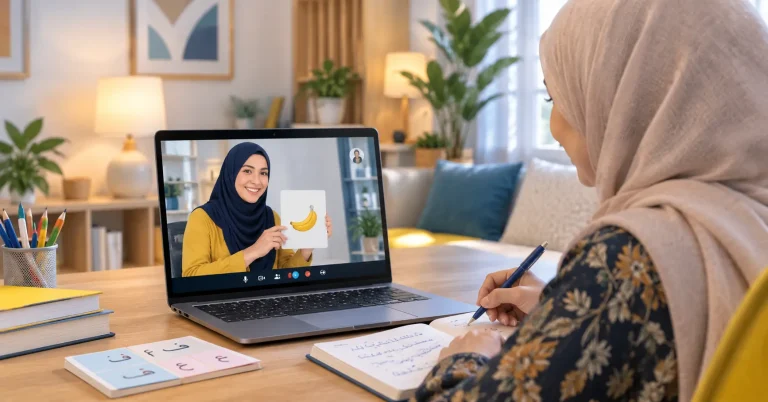
"Child learning Arabic letters in online Arabic classes for kids with a Daad Academy teacher"

Ready to start your journey?

Book Your FREE Trial Session

Online Arabic Classes for Kids: Course Overview

LevelComplete beginner to intermediate, set by a level check
FormatOne-to-one, live online
PlanPlanned around 12 weeks per level, with six stages over about a year
Lessons3 lessons a week, 30 minutes each
Ages5 to 16
LanguageArabic and English
SkillsReading, writing, listening, speaking, vocabulary and basic grammar
MaterialsNoor Al-Bayan, Salsabil, Ta’allam Al-Arabiyya, Al-Arabiyya Bayna Yadayk, Uhibbu Al-Lugha Al-Arabiyya and Al’ab wa Ta’allam

Which Children Learn Best in This Course

Complete Beginners (Ages 5 and Above)

Your child has never seen an Arabic letter. The course starts at the first letter and builds step by step.

Children Who Speak Arabic at Home

They understand Arabic but cannot read or write it. Lessons build the missing reading and writing skills.

Children Who Feel Stuck in Group Classes

One-to-one lessons find the exact gap and work on it, instead of moving ahead and leaving confusion behind.

Children Preparing for Quran Reading

A solid reading base comes first. When your child is ready, the Noorani Qaida course continues the path.

Course Curriculum, Stage by Stage

UNIT 01

Stage 1: Letters and Sounds (Weeks 1-4)

▼
Children learn the Arabic letters, their names and their sounds, with playful exercises that keep young learners engaged.
UNIT 02

Stage 2: Reading Readiness (Weeks 5-8)

▼
Short vowels, joined letter forms and simple two- and three-letter words, read aloud in every lesson.
UNIT 03

Stage 3: Words, Writing and Vocabulary (Weeks 9-12)

▼
Writing practice alongside reading, basic noun and verb vocabulary, simple classroom phrases, and tanween, sukoon and shaddah.
UNIT 04

Stage 4: Short Sentences and Conversation Starters (Months 4-6)

▼
Children form simple sentences and answer the teacher’s questions in Arabic across topics such as family, colours, numbers and the body.
UNIT 05

Stage 5: Reading Fluency and Basic Grammar (Months 6-9)

▼
Reading with more speed and accuracy, singular and plural, masculine and feminine, and short paragraph reading with comprehension.
UNIT 06

Stage 6: Quran Reading Readiness (Months 9-12)

▼
Children who have finished the reading path are ready to begin Quran reading, while their conversational Arabic keeps growing.

Supporting Your Child’s Arabic at Home

  • Ask your child to read a few lines aloud each day, even for five minutes
  • Label everyday objects at home with their Arabic names
  • Review the words from the last lesson before the next one begins
  • Let your child teach you one new Arabic word each week
  • Praise effort, not speed, so your child keeps enjoying the language

Why Learn With Daad Academy

One-to-one lessons: every lesson focuses on a single child, so each mistake is noticed and corrected.

Native Al-Azhar graduate teachers: lessons are taught in Arabic and English by qualified, certified, native Arabic-speaking teachers who graduated from Al-Azhar University.

A pace set by your child: a level check decides where to begin, and the pace adjusts to your child.

Four skills in one course: reading, writing, listening and speaking are built together.

Progress shared with parents: parents receive progress updates so they can see what has been achieved.

A free trial first: your child can meet the teacher before you decide.

وَقُل رَّبِّ زِدْنِي عِلْمًا
“And say, ‘My Lord, increase me in knowledge.’” (Surah Ta-Ha, 20:114)

Knowledge is a gift to ask Allah for, and every language begins with small, patient steps. For a child, each new Arabic letter is one of those steps.

How to Get Started

1

Book Your Free Trial: Choose a time and let your child meet the teacher in a real one-to-one session.

2

Take the Level Check: The teacher listens to your child read and speak, then decides where to begin.

3

Start the Lessons: Lessons begin at the right stage, 3 times a week, at times agreed in your child’s local time zone.

What Parents Say

★★★★★

"Dua, USA"

My daughter Ruqayyah from the USA started her Arabic course with almost no prior knowledge of the language. Now, she can read Arabic, understand simple words and sentences, and even have conversations with her Arab friends! I'm so happy to see how much confidence she has gained and how excited she is to use Arabic in her daily life. The lessons have made learning enjoyable, engaging, and effective. We're truly grateful for this amazing progress!
★★★★★

"Mohamed, Australia"

I'm very pleased with the progress my son Ali has made in his Arabic course at Daad Academy. It's wonderful to see how his reading skills and understanding of Arabic have improved over time. The teachers are supportive, patient, and committed to helping students succeed. Seeing Ali's development has given me great confidence in the academy, and I've recommended Daad Academy to several of my friends who are looking for quality online Arabic lessons for their children. Thank you for making this learning journey such a positive experience!

Where Your Child Can Go Next

Students who enrolled in this course also advanced their foundational knowledge with these related programs:

Arabic Classes Arabic Lessons For Beginners

Arabic Lessons For Beginners

Arabic lessons for beginners at Daad Academy start from the very first letter, with live one-to-one lessons and a n...

From Zero 6 Milestones 1-on-1
Arabic Classes Arabic Classes For Adults

Arabic Classes For Adults

Arabic classes for adults at Daad Academy are live, one-to-one lessons built around adult life. Choose the goal tha...

Adults 1-on-1 6 Goals
Arabic Classes Arabic Grammar Course

Arabic Grammar Course

The Arabic grammar course at Daad Academy teaches Nahw (how sentences are built) and Sarf (how words are formed) in...

Nahw + Sarf 1-on-1 Madinah Arabic

Questions About Online Arabic Classes for Kids

What age is the course suitable for?−
The course is for children aged 5 to 16. A level check at the start places each child at the right stage.
How long does each level take?+
Each level is planned around 12 weeks with 3 lessons a week. The pace is adjusted to your child, and some children need longer on a stage to feel confident.
Can my child join with no Arabic at all?+
Yes. The course starts from the first letter and no Arabic knowledge is assumed.
My child speaks Arabic at home but cannot read it. Is this course suitable?+
Yes. The level check finds what your child already knows, so lessons focus on reading and writing instead of repeating spoken Arabic.
Is this a Quran course?+
No. This course teaches Arabic as a language. For Quran reading, see the Noorani Qaida course, and for Quran lessons, see our online Quran classes for kids.
Is there a free trial?+
Yes. A free trial session is available so your child can meet the teacher first.

Online Arabic Classes for Kids: What Your Child Learns and How

Online Arabic classes for kids at Daad Academy teach Arabic as a language: reading, writing, listening, speaking and vocabulary. If your main goal is for your child to read the Quran, the Noorani Qaida course is the better starting point, and our online Quran classes for kids continue from there. This course builds the language base that supports school, family life and later study. If you are still deciding which type of Arabic to choose, learn Arabic online explains the options.

Why One-to-One Lessons Suit Children

Children learn a new script best when an adult watches every attempt. In a one-to-one lesson, the teacher hears each sound, notices each hesitation and corrects it straight away. There is no group pace to keep up with, so a child who needs more time on a letter gets it, and a child who is ready to move on is not held back.

Lessons are given in Arabic and English by native Arabic-speaking teachers who are graduates of Al-Azhar University, which helps children understand new words without feeling lost. A level check at the start shows the teacher where your child should begin.

The Four Skills Your Child Builds

  • Reading: from single letters to words and short sentences read aloud.
  • Writing: forming letters and common words neatly, from right to left.
  • Listening: understanding the teacher’s Arabic in simple, everyday phrases.
  • Speaking: answering questions and using new vocabulary in short conversations.

Together these four skills give a child a balanced foundation, so reading is never learned apart from speaking and writing.

How Children Learn the Arabic Alphabet

The Arabic alphabet has 28 letters and is written from right to left. Most letters change shape depending on where they sit in a word, so each letter is taught in its isolated and joined forms. Younger children begin with letter names and sounds through short, playful exercises, and then move on to simple words.

Short vowels, joined letters and early writing practice follow. By this point the child is reading aloud in every lesson, which is where the teacher’s live correction matters most.

From Letters to Sentences: The Six Stages

The course follows six stages: letters and sounds, reading readiness, words and writing, short sentences, reading fluency with basic grammar, and finally readiness for Quran reading. Each level is planned around 12 weeks, and the teacher adjusts the pace to your child instead of keeping to a fixed timetable.

What a One-to-One Lesson Can Look Like

Because the teacher is working with one child, the lesson can move at the child’s speed. The teacher can revise the last lesson’s letters or words, introduce something new, listen while the child reads aloud, and correct pronunciation or writing on the spot. A parent can sit nearby, especially with younger children, to help them settle in and stay focused.

Speaking and Vocabulary

Vocabulary is built around everyday topics such as family, numbers, colours, food and the body. Children first recognize the words, then use them in simple sentences, and then answer the teacher’s questions in Arabic. For children who already hear Arabic at home, this step connects what they understand to what they can say and write.

Why Start Arabic at a Young Age

Young children are used to learning new sounds and shapes, and they often enjoy the routine of short, regular lessons. Starting early also gives a child time to build reading, writing and vocabulary step by step, without pressure. For families who speak Arabic at home, it turns spoken understanding into confident reading and writing.

Choosing the Right Starting Point

  • Your child has never seen Arabic letters. Start at the first letter. No prior knowledge is needed.
  • Your child speaks Arabic at home but cannot read or write it. The level check finds what they already know, so lessons focus on reading and writing.
  • Your child already attends a weekend or madrasa class but feels stuck. One-to-one lessons can find the exact gap and work on it.
  • Your learner is older than 16. Look at our Arabic classes for adults.

How Parents Can Support Arabic at Home

  • Ask your child to read a few lines aloud each day, even for five minutes.
  • Label everyday objects at home with their Arabic names.
  • Review the words from the last lesson before the next one begins.
  • Let your child teach you one new Arabic word each week.

What Comes After This Course

Once your child reads steadily, families can add online Islamic classes for kids for the basics of faith, or an online Tajweed course for kids once Quran reading has begun.

Start With a Free Trial

A free trial session lets your child meet the teacher and try a real lesson before you decide. Book a free trial session for online Arabic classes for kids and see where your child will begin.

Give Your Child a Strong Start in Arabic

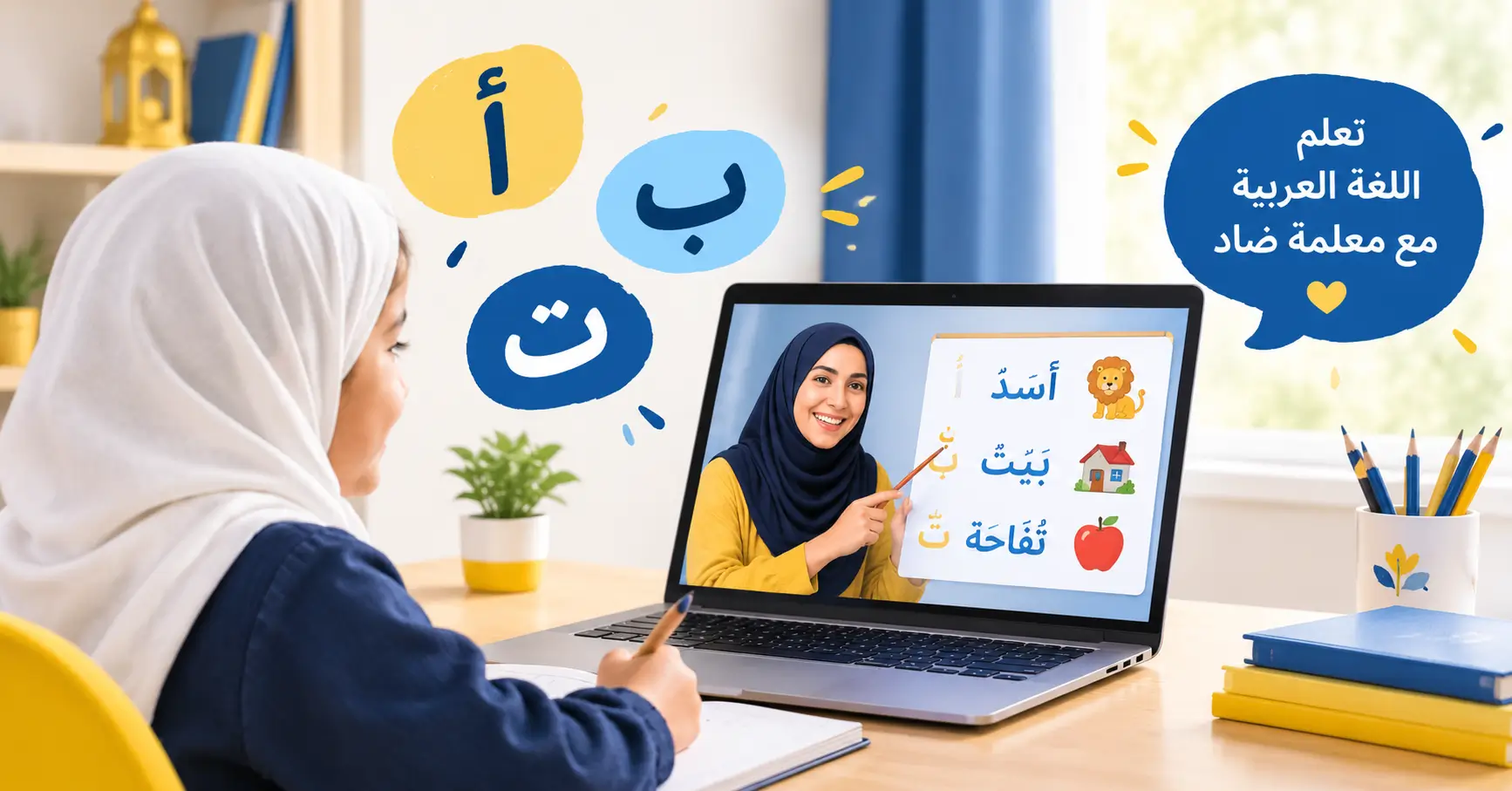
Arabic can feel unfamiliar at first, especially when letters run from right to left and change shape inside a word. That is normal, and children settle in when someone is patient with every step.

With one-to-one online Arabic classes for kids, your child learns the letters, builds vocabulary and begins to read, write and speak at a pace that suits them.

Book a free trial session and let your child meet their teacher.